
What if a painful memory could lose its emotional sting without erasing the story itself?
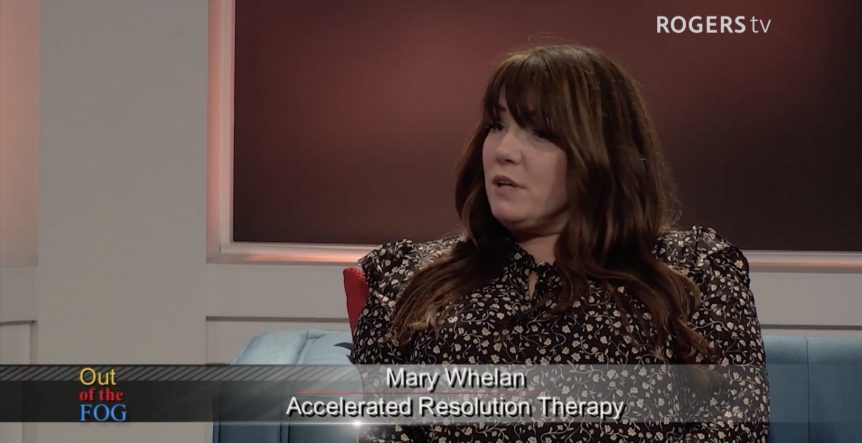
That question was explored in a recent segment on Out of the Fog, a community program produced by Rogers TV in St. John’s, Newfoundland Canada. The episode featured a conversation about Accelerated Resolution Therapy (ART).
The segment highlighted both the science behind ART and the personal experiences of clinicians who use it.
A Personal Story Behind Accelerated Resolution Therapy
ART trainer Mary Whelan shared the experience that first introduced her to Accelerated Resolution Therapy.
During her ART training, she participated as a client and chose to work on the memory of her mother’s death when she was twelve. That moment had stayed vivid in her mind for years.
“That image had stung me for quite a long time. I was one of the students in the training and within the hour, I couldn’t see it anymore. Once it was erased, what I envisioned instead was something that my brain chose for me based on our experiences when I was little and the new images were so warm and beautiful.
If I tried now, I cannot go back and find that image. I know what happened. I can describe it. I can’t see it. And it’s by changing the images, the body no longer feels the experience of the trauma because that’s how trauma is stored in the body and the memories. So it changes how it’s stored in the body so you don’t experience the trauma anymore in terms of the sensations and the emotions, but you don’t forget it.”
Mary explained how her experience with Accelerated Resolution Therapy (ART) brought more balance to her career. After years of working in complex trauma since 2001, a supervisor noticed she often felt overly responsible when clients expressed suicidal thoughts. Through ART, Mary connected that intense reaction to the loss of her mother and the feeling she needed to save others. Once that memory was processed, the hypervigilance lifted. She could still respond appropriately to clients in crisis, but without the overwhelming sense of personal responsibility. The shift, she says, “really changed my whole outlook on my career,” allowing her to approach her work with greater clarity and emotional balance.
Why ART Focuses on the Nervous System
One of the most memorable moments in the interview came when Mary explained how she helps people understand ART.
“Trauma is a nervous system issue. It’s not a story issue.”
Traditional talk therapy often involves revisiting painful events through conversation. While that can help some people, others may feel stuck repeating the same story without relief.
ART uses bilateral eye movements and guided imagery to help the brain update how traumatic memories are stored. Instead of analyzing the event repeatedly, the therapy focuses on how the memory is experienced in the brain and body.
As Mary described her role in the process:
“I’m just the tour guide. The brain does the changes.”
She also noted that many clients react with surprise after their sessions.
“Some of the phrases we hear are the disbelief, the shaking of the head, the ‘oh my God, this is amazing,’ ‘wow,’ and confusion by the immediacy.”
From Grief to Gratitude: A Clinician’s Experience
The segment also featured Kendall Dwyer, who first experienced ART during training and now uses it in her own clinical practice.
She described the approach as powerful and efficient.
“It’s definitely been such a game changer. It just kind of gets right to the heart of the matter.”
During training, Kendall chose to work on the death of a family member. The shift she experienced surprised her.
“I literally went from grief to gratitude in that training.”
Kendall also emphasized that trauma does not always come from major life events.
“I don’t believe there’s a person out there that exists that’s never experienced a trauma. So if you’ve been bullied in middle school…if there’s an embarrassing moment, it’s not just the big things like car accidents or anything like that. It could also be like more micro traumas. Sometimes micro traumas can build up over time as well. So you don’t necessarily have to have the diagnosis of PTSD to benefit from Accelerated Resolution Therapy.”
ART offers a way to process those memories without requiring clients to describe every detail out loud.
As Kendall explained:
“You don’t have to talk in a whole lot of detail about the trauma.”
Watch the Full Rogers TV Interview
The Out of the Fog segment offers a thoughtful introduction to Accelerated Resolution Therapy (ART), an emerging trauma-focused therapy that uses bilateral eye movements and imagery to help the brain process difficult memories. Many clinicians are integrating ART into their practices to effectively treat symptoms of trauma, anxiety, grief, and other stress-related experiences.